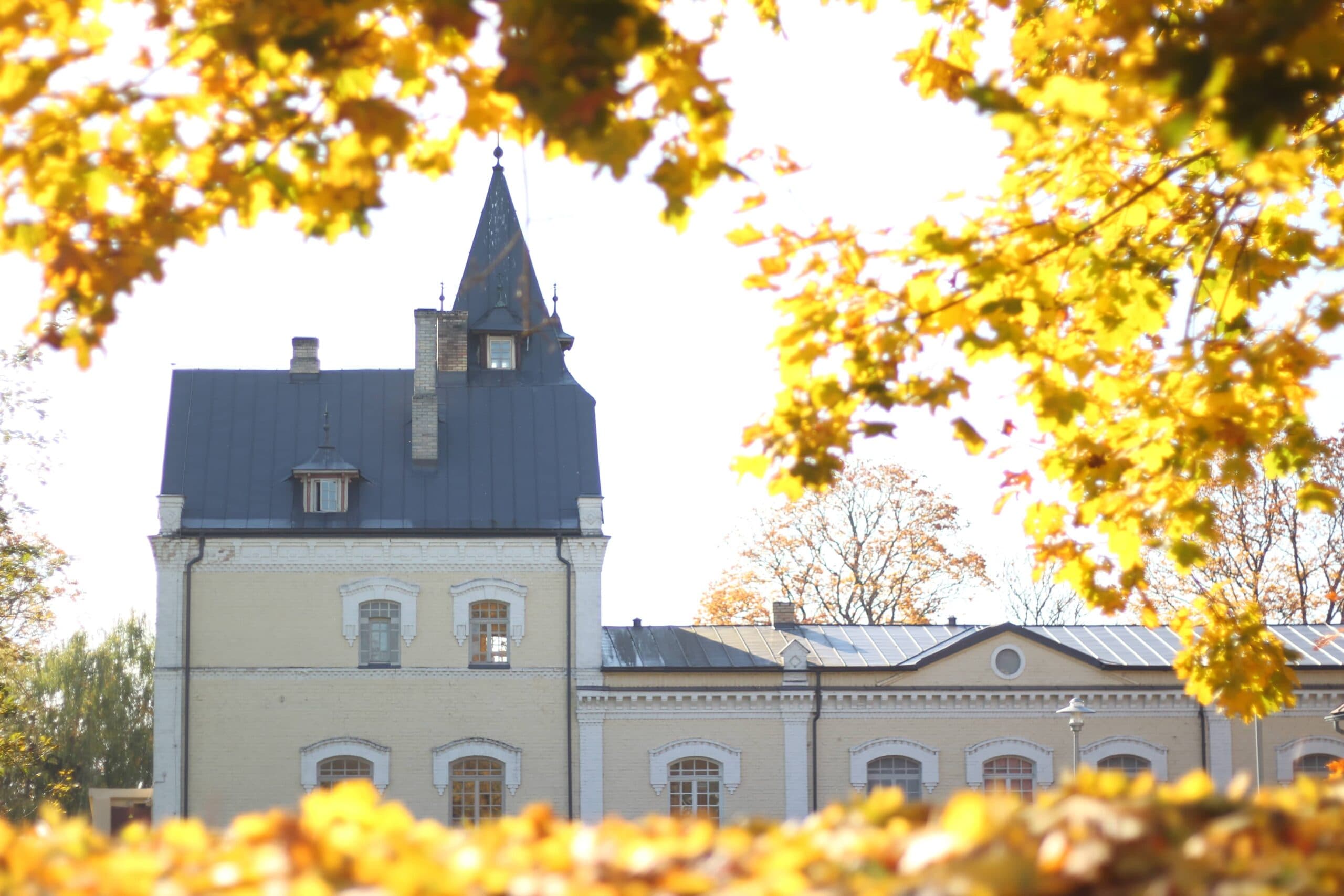
Dole Manor Park (Daugava Museum)
Dole Manor Park is a great example of late 18th to early 19th century landscaping. The park began to be created in 1776 when the manor belonged to patron of theatre Baron Otto Hermann von Fittinghof (1722–1792), and has continued to evolve for more than 200 years. Old trails still wind through plantations of beautiful trees, which include several rare varieties, along the banks of the River Daugava and through historical sites that tell of the park’s origin and history.
One trail leads along the banks of the River Daugava that starts at the Daugava Museum in the historic Dole Manor. Bright rose bushes in front of the manor delight visitors upon arrival. A beautiful square of ornamental trees and shrubs has been created next to the manor since the museum was established there. Its main features are a weeping willow (Salix babylonica) and several blue spruces (Picea pungens f. glauca). A beautiful view of the river opens up walking from the museum towards the River Daugava.
Several notable trees grow along the sides of the trail. The stately linden tree deserves to be mentioned first – it was planted by the President at the time, Vaira Vīķe-Freiberga, on 1 May 2004, which was the day that Latvia joined the European Union. Walking further you can see Dole Manor Park’s stately oak (Quercus robur), which is 4m in circumference. Close by stands the no less magnificent Norway maple (Acer platanoides), which is 3.7m in circumference. Further on, the trail passes by the Mellupi ethnographic open-air farmstead and ends at a memorial site consisting of a group of stone sculptures dedicated to the houses destroyed by flooding during the construction of the Riga Hydroelectric Power Plant.
In the depths of the park you can find more natural wonders. Over 40 different rare trees grow here including the sweet birch (Betula lenta), which is scarce in Latvia. Two of these rarities, the tall Japanese larch (Larix kaempferi) and the dense Macedonian or Balkan pine (Pinus peuce Griseb.), are well established close to the park’s only historical site – a memorial obelisk erected in the latter half of the 19th century. The obelisk was set here to honour the last owners of the manor, the von Löwis of Menar family, who were Baltic Germans of Scottish origin. From the obelisk the trail leads to two large circular spaces in which colourful rhododendron bushes bloom brightly in the spring. The two circles are connected by an alley of linden trees, which has been growing here since the manor was inhabited.
Detailed Information
Information about ticket prices https://www.daugavasmuzejs.lv/cenradis
Museum, educational programs.
An orienteering range with 10 checkpoints is open in the Daugava Museum Park. The orienteering range is available throughout the year during museum opening hours in the open-air area. There is no additional fee for visiting it, you just need to purchase museum entrance tickets according to the current price list. Instructions for the orienteering range can be found on the museum website – in the “discover and experience” section, selecting “excursions”. The visit does not need to be booked in advance.
A tactile map of the Daugava Museum Park has been installed at the main entrance to the Daugava Museum. It is designed to help visitors with visual impairments gain an understanding of the park's layout and the location of its facilities and services.
Reviews
No reviews yet.